Mihir Chavda to Present Group Research at ACS Fall 2026
August 21, 2026
Mihir Chavda will be delivering an oral presentation on our group’s latest methodology and natural product synthesis at the upcoming ACS Fall 2026 National Meeting in Chicago.
![Reaction scheme for the synthetic route to zamamiphidin A: an unsaturated O-methyl hydroxamate (a cyclohexene bearing a pendant butenyl chain and a CH2C(=O)NHOMe group) is converted in two steps into a tricyclic amino alcohol that contains a macrocyclic ring and the cage-like 2-azabicyclo[3.3.1]nonane core. At right, the full structure of zamamiphidin A is shown in a dashed box, with the corresponding substructure highlighted in red.](files/scheme-zamamiphidin-2026.png)
Congratulations to Mihir on the upcoming talk! If you will be attending ACS Fall 2026, make sure to stop by Room W180 on Thursday morning to hear about the project.
- Speaker: Mihir Chavda
- Presentation Title: Iodine(III)-Mediated Intramolecular Oxamidation of Unsaturated O-Alkyl Hydroxamates: Application to the Tricyclic Core and Macrocyclic Ring A of Zamamiphidin A
- Division: Division of Organic Chemistry (ORGN)
- Session: Total Synthesis of Complex Molecules (8:00 AM – 12:00 PM CDT)
- Format: In-Person Oral Presentation
- Date & Time: Thursday, August 27, 2026 | 11:20 AM – 11:40 AM CDT
- Location: Room W180, McCormick Place Convention Center
Congratulations to Mihir on the upcoming talk! If you will be attending ACS Fall 2026, make sure to stop by Room W180 on Thursday morning to hear about the project.
Tetrazolone-based HDAC6 inhibitors published in J. Med. Chem.
July 29, 2026
Congratulations to Sruthi Mohan, Sebastian Marquez, Mario Noboa and Tim Ponsot, whose work appears in the Journal of Medicinal Chemistry: “Macrophage-Centric Phenotypic Screening Identifies Tetrazolone-Based HDAC6 Inhibitors That Reprogram the Tumor Immune Microenvironment and Improve Immune Checkpoint Blockade,” J. Med. Chem. 2026, 69(11), 12870–12897. DOI: 10.1021/acs.jmedchem.5c02453
This paper is the product of years of sustained effort, and reflects real dedication from everyone involved. It spans two generations of the group: Mario and Tim are graduate students here now, while Sruthi and Sebastian have since completed their doctorates and now work at Argonne National Laboratory and AbbVie, Inc., respectively. The study was carried out in collaboration with the research groups of Alejandro Villagra at Georgetown University and Cyril Bařinka at the Institute of Biotechnology of the Czech Academy of Sciences.
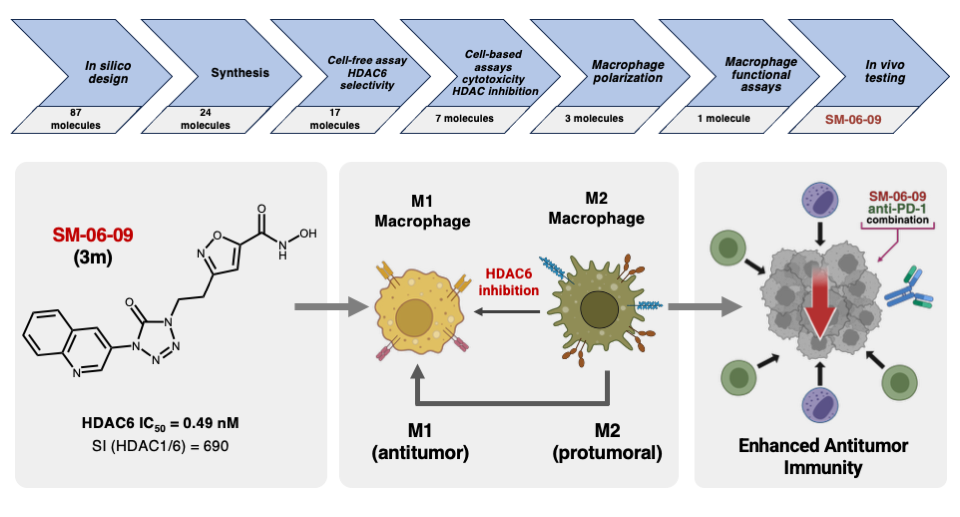
This paper is the product of years of sustained effort, and reflects real dedication from everyone involved. It spans two generations of the group: Mario and Tim are graduate students here now, while Sruthi and Sebastian have since completed their doctorates and now work at Argonne National Laboratory and AbbVie, Inc., respectively. The study was carried out in collaboration with the research groups of Alejandro Villagra at Georgetown University and Cyril Bařinka at the Institute of Biotechnology of the Czech Academy of Sciences.
Chris Vazquez and Rishav Chatterjee Pass Preliminary Examinations
May 16, 2026
Congratulations to Chris Vazquez and Rishav Chatterjee on passing their doctoral preliminary examinations.
Chris is developing a series of histone deacetylase 10 (HDAC10) inhibitors, and new tetrazolone scaffolds for HDAC11 inhibitors. Rishav’s research focuses on HDAC6 inhibitors and the total synthesis of himalensine A.
This milestone reflects their scientific progress and sustained effort. Congratulations, Chris and Rishav!
Chris is developing a series of histone deacetylase 10 (HDAC10) inhibitors, and new tetrazolone scaffolds for HDAC11 inhibitors. Rishav’s research focuses on HDAC6 inhibitors and the total synthesis of himalensine A.
This milestone reflects their scientific progress and sustained effort. Congratulations, Chris and Rishav!
CTRI award to test HDAC6 inhibitors in Charcot-Marie-Tooth disease
May 1, 2026
The group has been awarded a UIC Chancellor’s Translational Research Initiative (CTRI) award, with Duncan Wardrop as principal investigator, for “Testing HDAC6 Inhibitors for Charcot-Marie-Tooth Disease using Patient-Specific iPSCs.”
Charcot-Marie-Tooth disease is the most common inherited disorder of the peripheral nerves, affecting roughly one person in 2,500. The nerves that carry signals between the spinal cord and the limbs degenerate slowly, so weakness and muscle wasting begin in the feet and lower legs and later reach the hands, together with loss of sensation and changes in the shape of the foot. It is rarely life-threatening, but it is progressive and disabling, and no treatment yet alters its course.
HDAC6 is an attractive target here because it strips acetyl groups from α-tubulin, a building block of the tracks along which cargo is carried up and down nerve axons. Inhibiting HDAC6 raises tubulin acetylation and restores that transport in laboratory models of the disease. The award supports testing the group’s HDAC6 inhibitors in nerve cells grown from patients’ own induced pluripotent stem cells (iPSCs), which carry the mutations responsible for their disease.
The work is a collaboration with Xue-Jun (June) Li, Michael A. Werckle Endowed Professor of Biomedical Sciences at the UIC College of Medicine Rockford, whose laboratory builds iPSC-based models of neurological disease. Mario Noboa and Rishav Chatterjee are carrying out the project.
Charcot-Marie-Tooth disease is the most common inherited disorder of the peripheral nerves, affecting roughly one person in 2,500. The nerves that carry signals between the spinal cord and the limbs degenerate slowly, so weakness and muscle wasting begin in the feet and lower legs and later reach the hands, together with loss of sensation and changes in the shape of the foot. It is rarely life-threatening, but it is progressive and disabling, and no treatment yet alters its course.
HDAC6 is an attractive target here because it strips acetyl groups from α-tubulin, a building block of the tracks along which cargo is carried up and down nerve axons. Inhibiting HDAC6 raises tubulin acetylation and restores that transport in laboratory models of the disease. The award supports testing the group’s HDAC6 inhibitors in nerve cells grown from patients’ own induced pluripotent stem cells (iPSCs), which carry the mutations responsible for their disease.
The work is a collaboration with Xue-Jun (June) Li, Michael A. Werckle Endowed Professor of Biomedical Sciences at the UIC College of Medicine Rockford, whose laboratory builds iPSC-based models of neurological disease. Mario Noboa and Rishav Chatterjee are carrying out the project.
Organosilicon influenza entry inhibitors published in J. Med. Virol.
May 28, 2025
Congratulations to Nik Hafeman, whose work appears in the Journal of Medical Virology: “Inhibition of Influenza Entry by Organosilicon Compounds,” J. Med. Virol. 2025, 97(6), e70436. DOI: 10.1002/jmv.70436
tert-Butylhydroquinone (TBHQ) was among the first small molecules shown to block influenza entry, but it oxidises readily in solution to the far less active quinone. This work replaces the tert-butyl group with trimethylsilyl, giving compounds that are both more stable in solution and more potent against viruses carrying Group 2 haemagglutinin. NMR shows the silicon-containing analogues occupy the same pocket, making stronger hydrophobic contacts within it.
Nik did this chemistry as an undergraduate at UIC. He went on to complete his PhD at Caltech with Brian Stoltz, and is now Senior Scientist II in Process Chemistry at AbbVie in North Chicago.
The study was carried out in collaboration with the research groups of Michael Caffrey and Lijun Rong at UIC, and Balaji Manicassamy at the University of Iowa.

tert-Butylhydroquinone (TBHQ) was among the first small molecules shown to block influenza entry, but it oxidises readily in solution to the far less active quinone. This work replaces the tert-butyl group with trimethylsilyl, giving compounds that are both more stable in solution and more potent against viruses carrying Group 2 haemagglutinin. NMR shows the silicon-containing analogues occupy the same pocket, making stronger hydrophobic contacts within it.
Nik did this chemistry as an undergraduate at UIC. He went on to complete his PhD at Caltech with Brian Stoltz, and is now Senior Scientist II in Process Chemistry at AbbVie in North Chicago.
The study was carried out in collaboration with the research groups of Michael Caffrey and Lijun Rong at UIC, and Balaji Manicassamy at the University of Iowa.
Fall Commencement, 2023
December 29, 2023
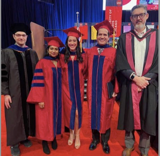
Congratulations to Drs. Sruthi Mohan, Jesba Bas Concepción, and Sebastian Marquez on receiving their Ph.D. degrees at the 2023 UIC Fall Commencement ceremony. This is a remarkable achievement that requires years of hard work, dedication, and perseverance. You have demonstrated your commitment to excellence and have made your family, friends, and colleagues proud.
Chris Vazquez has joined the Wardrop group
December 28, 2023
Chris graduated from Dominican University, majoring in chemistry and minoring in physics. Before joining the chemistry graduate program at UIC this fall, Chris worked at Particle Technology Labs as a Particle Characterization Chemist II. Chris will be working to develop selective inhibitors for HDAC11, the smallest and least explored member of the HDAC family