July 2026
Mihir Chavda to Present Group Research at ACS Fall 2026
August 21, 2026
Mihir Chavda will be delivering an oral presentation on our group’s latest methodology and natural product synthesis at the upcoming ACS Fall 2026 National Meeting in Chicago.
![Reaction scheme for the synthetic route to zamamiphidin A: an unsaturated O-methyl hydroxamate (a cyclohexene bearing a pendant butenyl chain and a CH2C(=O)NHOMe group) is converted in two steps into a tricyclic amino alcohol that contains a macrocyclic ring and the cage-like 2-azabicyclo[3.3.1]nonane core. At right, the full structure of zamamiphidin A is shown in a dashed box, with the corresponding substructure highlighted in red.](scheme-zamamiphidin-2026.png)
Congratulations to Mihir on the upcoming talk! If you will be attending ACS Fall 2026, make sure to stop by Room W180 on Thursday morning to hear about the project.
- Speaker: Mihir Chavda
- Presentation Title: Iodine(III)-Mediated Intramolecular Oxamidation of Unsaturated O-Alkyl Hydroxamates: Application to the Tricyclic Core and Macrocyclic Ring A of Zamamiphidin A
- Division: Division of Organic Chemistry (ORGN)
- Session: Total Synthesis of Complex Molecules (8:00 AM – 12:00 PM CDT)
- Format: In-Person Oral Presentation
- Date & Time: Thursday, August 27, 2026 | 11:20 AM – 11:40 AM CDT
- Location: Room W180, McCormick Place Convention Center
Congratulations to Mihir on the upcoming talk! If you will be attending ACS Fall 2026, make sure to stop by Room W180 on Thursday morning to hear about the project.
Tetrazolone-based HDAC6 inhibitors published in J. Med. Chem.
July 29, 2026
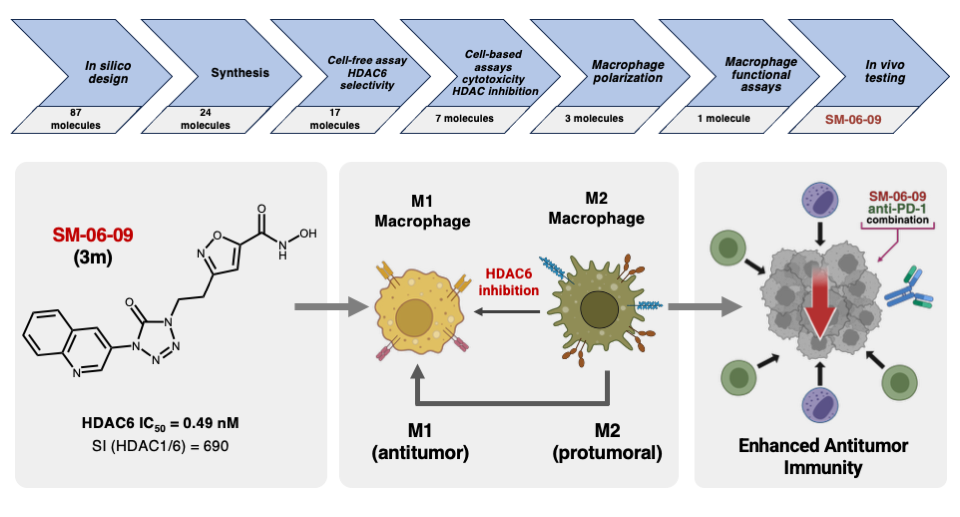
Congratulations to Sruthi Mohan, Sebastian Marquez, Mario Noboa and Tim Ponsot, whose work appears in the Journal of Medicinal Chemistry: “Macrophage-Centric Phenotypic Screening Identifies Tetrazolone-Based HDAC6 Inhibitors That Reprogram the Tumor Immune Microenvironment and Improve Immune Checkpoint Blockade,” J. Med. Chem. 2026, 69(11), 12870–12897. DOI: 10.1021/acs.jmedchem.5c02453
This paper is the product of years of sustained effort, and reflects real dedication from everyone involved. It spans two generations of the group: Mario and Tim are graduate students here now, while Sruthi and Sebastian have since completed their doctorates and now work at Argonne National Laboratory and AbbVie, Inc., respectively. The study was carried out in collaboration with the research groups of Alejandro Villagra at Georgetown University and Cyril Bařinka at the Institute of Biotechnology of the Czech Academy of Sciences.
This paper is the product of years of sustained effort, and reflects real dedication from everyone involved. It spans two generations of the group: Mario and Tim are graduate students here now, while Sruthi and Sebastian have since completed their doctorates and now work at Argonne National Laboratory and AbbVie, Inc., respectively. The study was carried out in collaboration with the research groups of Alejandro Villagra at Georgetown University and Cyril Bařinka at the Institute of Biotechnology of the Czech Academy of Sciences.