Research Projects
-
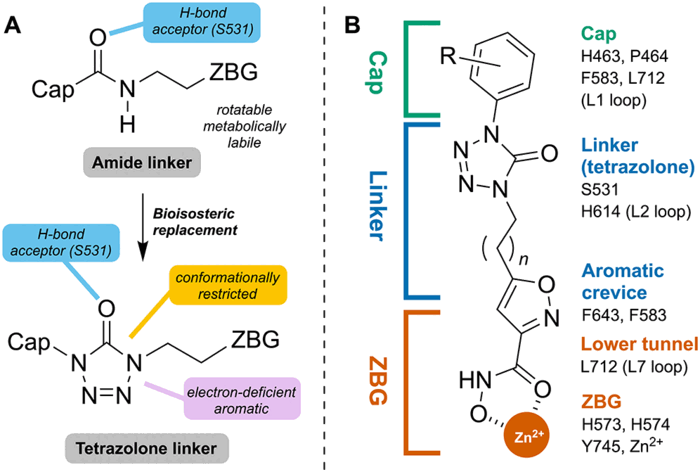 Balanced Dual HDAC6/HDAC10 Inhibitors to Improve Cancer ImmunotherapyTumor-associated macrophages are principal drivers of resistance to immune checkpoint blockade, and their rapid conversion to an immunosuppressive, protumoral state within the tumor microenvironment has limited the success of macrophage-based cell therapies. In collaboration with the laboratory of Alejandro Villagra at Georgetown University’s Lombardi Comprehensive Cancer Center, we have shown that selective histone deacetylase (HDAC) inhibitors reprogram macrophages toward an antitumor phenotype, enhancing phagocytosis and antigen presentation, restoring T-cell activation, and suppressing tumor growth in melanoma, breast, and ovarian cancer models. These effects arise from immune modulation rather than direct tumor cytotoxicity.
Systematic profiling of our compound series has produced an unexpected result. The molecules that reprogram macrophages most effectively are not the most HDAC6-selective, but rather those that also inhibit HDAC10. Comparative studies using selective inhibitors together with HDAC6-, HDAC10-, and double-knockout macrophages establish that balanced inhibition of both isoforms, rather than either enzyme alone, is the principal driver of this reprogramming, and transcriptomic analysis indicates that the two enzymes govern largely non-overlapping pathways. Using a macrophage-centric phenotypic screening platform, we have identified the tetrazolone-based inhibitor SM-06-09, which suppresses tumor growth and markedly potentiates anti-PD-1 therapy in a syngeneic melanoma model. This work was reported recently in the Journal of Medicinal Chemistry.
Our current efforts are directed toward the design and synthesis of next-generation inhibitors with tunable HDAC6:HDAC10 potency ratios, developed both as systemic immunomodulators and as agents for the ex vivo reprogramming of macrophages prior to adoptive transfer.
This research is supported by the National Cancer Institute of the NIH under award number R01CA249248. -
 Target-Directed SynthesisIn conjunction with our interest in the chemistry of nitrenium ions and alkylidenecarbenes, we are actively involved in the total synthesis of natural products. Current targets include the alkaloids zamamiphidin A and himalensine A. The unifying structural feature of these complex, cage-like molecules is the 2-azabicyclo[3.3.1]nonane ring system (shown in red), which is also present in more than 300 natural products, distributed across an array of biogenetic groups that includes the Strychnos and Daphniphyllum alkaloid families. Having recently reported the development of a π+N+-type alkene oxamidation strategy for the preparation of the morphan core of madangamine D, we are now applying this approach to other targets in this group.
 -
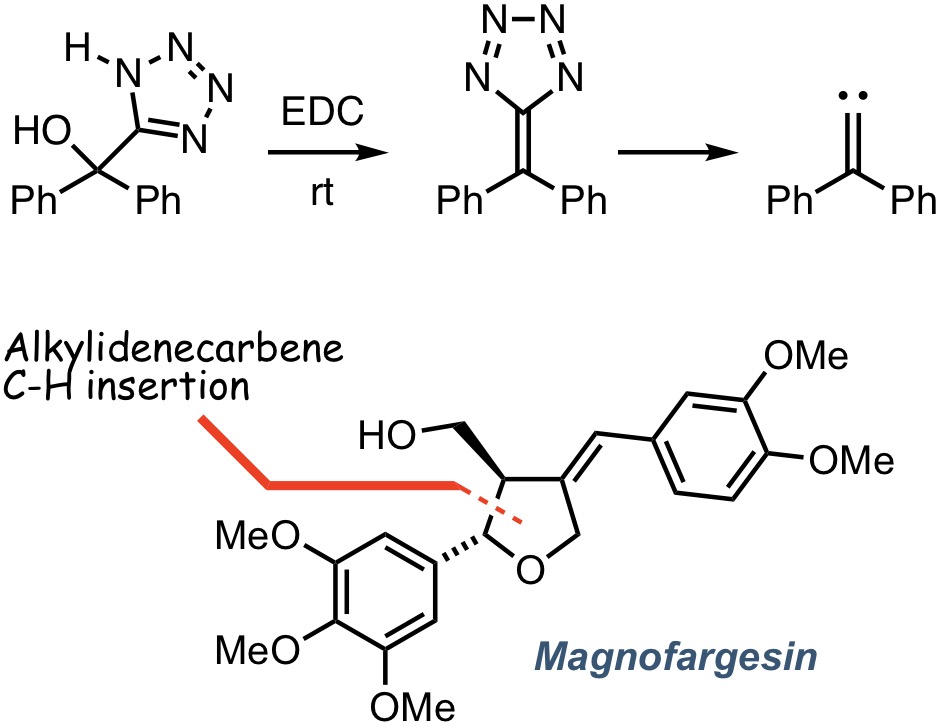 Chemistry of AlkylidenecarbenesWe have a long-standing interest in the generation and reaction of alkylidenecarbenes, transient, electron deficient species, which undergo a number of synthetically valuable reactions, including [1,2]-rearrangement, ylide formation, alkene cyclopropanation and [1,5]-C-H bond insertion. Over the last decade or so, we have studied the latter transformation as a means to access N- and O-heterocycles and natural products that encompass these ring systems, including the platelet-activating factor antagonist magnofargesin. We are also interested in the discovery of new methods for the generation of alkylidenecarbenes. In this regard, we have developed a mild, base-free method for the generation of alkylidenecarbenes involving the dehydrative fragmentation of 5-hydroxyalkyl-1H-tetrazoles. Further investigations of this unusual reaction are currently underway.
 -
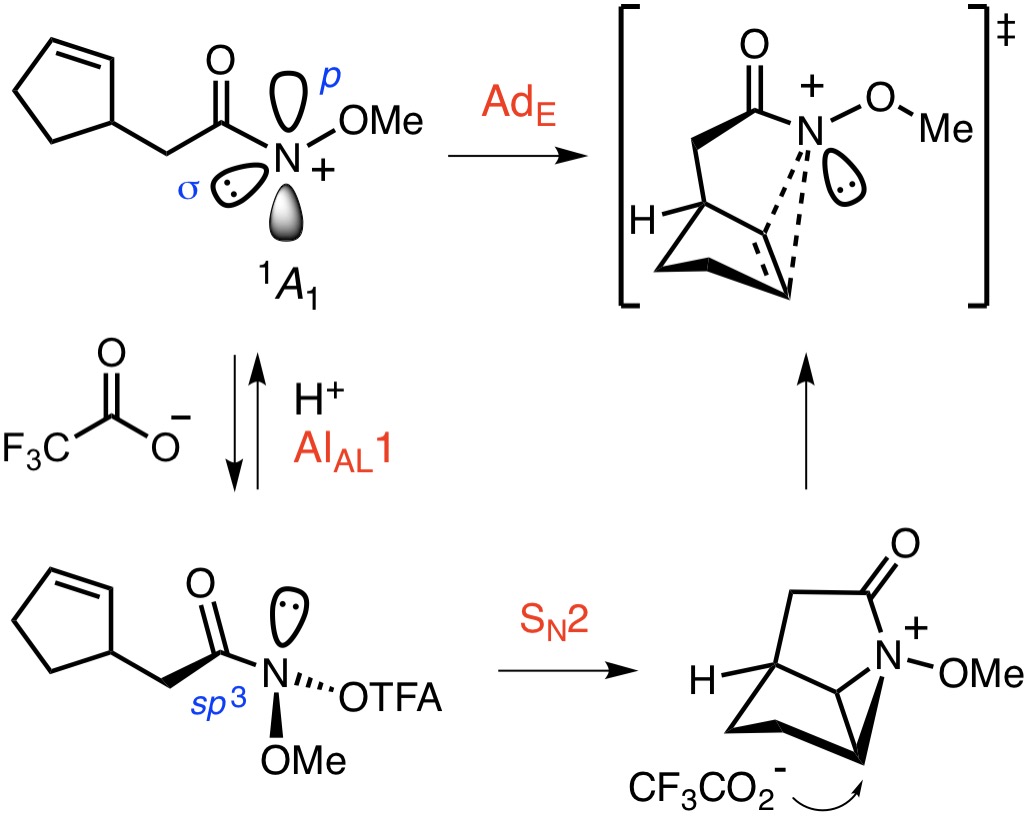 Nitrenium Ion ChemistryAlthough the existence of nitrenium ions has been demonstrated for for some time, the potential of these divalent N-electrophiles as tools for target-directed synthesis, has yet to be fully realized. Nitrenium ions have often been viewed as the poor cousins of cations, carbenes and nitrenes, their isoelectronic congeners within the electron-deficient branch of the reactive intermediate family. Our research in this area is directed towards the exploration of nitrenium ion chemistry and its application to the synthesis of saturated N-heterocycles, including alkaloid natural products. Most recently, we have reported a novel approach to the diazatricyclic core of madangamine D, which involves the π–N+-type cyclization of an unsaturated O-methyl hydroxamate. The total synthesis of madangamine D and the application of this chemistry to other morphan-based targets is underway.